 ™
™
Quick Answer
The Short Answer
Bandwidth-sharing apps are moving toward clearer user controls. Pause buttons, network-type selection, and reward transparency are being pushed forward by how device type shapes what bandwidth contribution actually earns on each node. Grass is already built around this principle: real home connection requirements, encrypted web routing, and a pause control that preserves your points.
The question isn't whether these controls are coming - it's which apps have the architecture ready when expectations arrive. AppEsteem-certified security, device-aware reward tiers, and clearly disclosed data-access policies are the three signals I look for when evaluating any bandwidth-sharing app. Grass checks all three.
During Stage 2, the Grass network already differentiated rewards by platform. The Android app, desktop, and Chrome extension each earned at different rates by device type and connection quality. Controls that reflect how contributions actually work are exactly where the market is heading.
Bandwidth sharing refers to sharing unused internet capacity with a network that routes public web data requests through your real home connection. According to Virgin Media O2, more than a third of all phone use now takes place without clear intent. Background apps are part of that unexamined screen time. The apps that build the consent-first stack - pre-install transparency, connection type requirements, and a reliable pause control - are the ones that will define the category standard.
A bandwidth-sharing app is a background service that contributes the idle portion of your home internet connection to a network used for gathering public web data. The term "idle bandwidth" means that the connection's unused capacity - the gap between what you're paying for and what you're actively using at any given moment - becomes a resource another party can route web data requests through.
Grass is one of the few apps that structures this process by device type. During Stage 2, the network differentiated rewards between the Android app, the desktop app, and the Chrome extension - a design choice that reflects how connection quality and device context affect the value of a node's contribution. In practice, that's what a consent-first architecture looks like before the industry has a name for it.
According to Virgin Media O2's Digital Wellbeing Manifesto - which commissioned a five-year Cambridge University study on how people actually use connected devices - most screen activity happens in short, unplanned sessions rather than deliberate use. Background apps run through all of it. User-side data-access disclosures - what the app reads, what it doesn't, and when it's active - are the transparency feature the next generation of bandwidth-sharing apps will be asked to provide.
Pause controls are not a feature request. Transparency before install is not a differentiator yet. Both are becoming table stakes. The apps that treat these as design constraints today will be the ones that don't have to retrofit them when user expectations harden and the category matures.
What does monitoring your bandwidth actually tell you - and what does it miss?
Standard monitoring shows bandwidth used per app. It doesn't explain why the same app earns 10x more Network Points on Android than on the Chrome extension.
People often assume they can keep track of a background app by opening Task Manager or checking their router's usage page. That assumption covers one narrow question - "is something using my connection right now?" - and breaks down the moment you ask anything deeper: what is this app actually doing with my bandwidth, what connection quality does it need, and is it doing something I'd want to allow if I fully understood it?
An analysis of home-network support discussions and monitoring tool documentation shows three layers of bandwidth visibility that users typically need to answer those questions:
- Process-level throughput - which app is using how many MB/s, readable from Task Manager or Resource Monitor
- Activity context - what the app is doing with that bandwidth: routing requests, maintaining a connection, reaching verified endpoints
- Outcome quality - whether that activity earns anything, contributes usefully, or meets the eligibility requirements the app actually applies
Standard tools cover the first layer reliably. The second and third are typically invisible. I call that gap - the distance between what your monitoring software shows and what actually determines how a sharing app performs - the visibility gap. Closing it is what clearer in-app controls are built to do.
According to Windows help forum discussions, users frequently can't identify which background process is consuming bandwidth, with Resource Monitor and third-party tools like Glasswire recommended as the step beyond Task Manager. Even those tools surface bytes transferred per process - not purpose, eligibility, or contribution quality. You can watch a background process drawing 3-4 Mbps and still have no way to tell whether it's reaching a legitimate endpoint, contributing anything useful, or being counted toward any reward at all.
The router layer doesn't close the gap either. Consumer QoS features are designed to prioritize traffic by device, but home-networking communities report consistently unreliable results. According to posts from users testing standard consumer routers, QoS "doesn't really seem to function satisfactorily" in real-world configurations - and genuine per-device bandwidth limits typically require prosumer hardware with significant manual setup. Most households don't run that equipment. So even if you wanted to throttle what a sharing app could use at the network level, the router probably won't cooperate reliably.
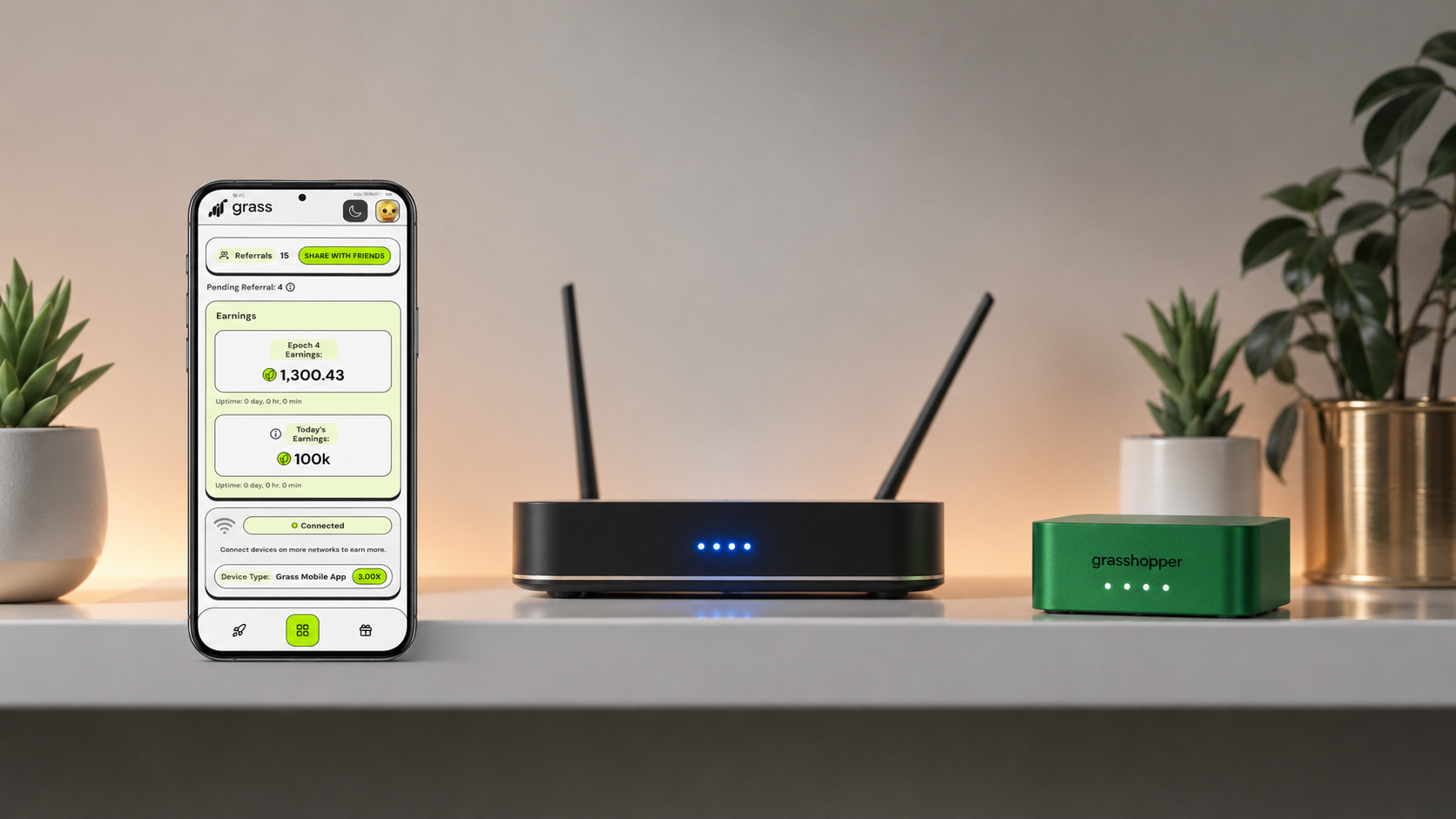
The Stage 2 reward structure makes the outcome layer concrete. Android app users earned a 10x Network Points bonus and a 3x Uptime Points bonus during Stage 2, versus a 5x Network Points and 2x Uptime Points bonus for desktop users, and the standard rate for the Chrome extension. No bandwidth monitor would have predicted that spread from traffic volume alone. The difference came from connection type - a real home connection, stable uptime, the right platform - not from the raw volume of bytes transferred.
Standard tools answer "did bandwidth move?" Bandwidth-sharing apps have to answer something harder: "did that bandwidth contribute in a way that meets eligibility criteria, and does the user know what that means?" Those aren't the same question. The tooling built to answer the first one can't resolve the second.
Pause controls, data disclosures, and network quality indicators are filling that gap - the industry's structural response to a monitoring problem that routers and operating systems haven't solved for consumers. Apps investing in transparency before the install are doing something the standard stack simply cannot.
Are bandwidth-sharing apps legit?
Legitimate bandwidth-sharing apps are transparent about what they access and how rewards are shaped. The doubt most people feel comes from a real gap: most apps don't answer those questions upfront.
The pitch sounds reasonable on its face. Typical home connections use only a fraction of their capacity during active use - often around 10% - leaving most of it idle at any given moment. That spare capacity is real. The honest question isn't whether the technology works - it does - but whether a given app is upfront about what it does with that capacity, who it routes it to, and what you receive in return. The disclosure often doesn't keep up with the pitch.
Reading through dozens of community discussions, the doubt concentrates not on the technology but on three concrete questions most apps don't answer clearly. Think of them as a simple legitimacy test - apps that can't answer all three tend to earn the doubt they get:
- Does the app explain what it accesses before you install? Not buried in a terms-of-service document - in plain language, on the download page or during onboarding.
- Does it explain what your rewards are based on? Vague "share idle bandwidth" framing doesn't tell you about connection-quality requirements, or what happens when several devices share the same network.
- Can you pause or stop anytime without penalty? A clean pause control and a simple uninstall are baseline signals of a trustworthy app. Anything that makes stopping difficult raises the question of what it's trying to prevent.
Apps that clear all three are the ones to trust. Apps that fail any one usually earn the caution they get.
One detail that rarely gets stated clearly: rewards are tied to each unique connection, not each device. Running the same app on several devices that share one home network doesn't multiply your contribution - it splits it. The takeaway is direct: connection quality matters more than device count. That caveat changes the "run it on every device" framing, and it tends to live in an FAQ rather than on the install page.
The natural follow-on: "If I can't easily verify what the app is doing, how do I know it's telling the truth?" A fair question - and one practical answer is third-party certification. Independent auditors like AppEsteem, which monitor apps continuously for vulnerabilities, backdoors, and malware, provide verification that can't be self-reported. An app carrying that certification has had its behavior checked by someone with no stake in making it look trustworthy. (Grass, for example, is AppEsteem-certified and answers all three questions above.)
It's worth knowing how hard independent verification is on your own. Users who want to monitor a background app's bandwidth find the options limited: Resource Monitor, GlassWire, and router-level allowlisting come up most often, with per-device throttling usually needing extra hardware or setup most people don't have. The gap between wanting to check what an app is doing and being able to is wider than most people expect - which is exactly why an app's own transparency has to do the work your operating system and router don't.
The doubt about bandwidth-sharing apps isn't irrational. The category's credibility depends on answering it directly - before you install, not after you complain. Apps that do that earn trust. Apps that don't lose it.
Why are transparency and pause controls becoming competitive necessities for bandwidth-sharing apps?
Device type already shapes how much a node contributes to the network. Controls that reflect that - network selection, clear data disclosure, device-aware reward tiers - are where the category is heading.
The institutional signals are arriving from outside the category. According to Virgin Media O2, more than a third of all phone use now takes place without clear intent - meaning a significant share of daily screen time is habitual or automatic rather than deliberate. Virgin Media O2 launched a Digital Wellbeing Manifesto and funded a five-year study with Cambridge University specifically around intentional device use, clearer guidance, and greater user control over what devices do in the background. That's a major telecom making transparency a product feature, not a legal footnote. In practice, when a provider at that scale frames background device activity as a wellbeing concern, it shifts the baseline expectation for every app running quietly in the background - including bandwidth-sharing apps.
The mobile shift adds its own pressure. According to research tracking global web traffic patterns, more than 65% of global web access now comes from mobile devices. Bandwidth-sharing apps on mobile face a different operating environment than desktop: carrier throttling, variable signal quality, and 5G coverage that frequently underperforms advertised speeds in real-world conditions. An app running on a mobile connection has to explain what happens when the connection degrades - not just how it performs at peak signal. That explanation is a form of control. The takeaway is concrete: mobile-first usage patterns raise the standard for what transparency looks like in practice.
An analysis of consumer demand signals, telecom transparency initiatives, and mobile usage data shows the shift toward explicit controls is expectation-driven, not regulatory. Users who found bandwidth-sharing apps through spare-capacity pitches are already asking whether those apps are trustworthy. The ones that answer that question clearly, before install rather than after the first complaint, are building something competitors have to match - or lose ground to.
The consent-first stack is what a fully transparent bandwidth-sharing app looks like in practice:
- Pre-install disclosure - plain-language explanation of what the app accesses and what it doesn't, on the download page, not inside a terms-of-service document
- Connection requirements - clear statement that only real home connections are supported, that VPNs produce zero network quality, and why that restriction exists
- In-session control - a pause button that works instantly, with no penalty to existing points balance or reward eligibility
- Reward transparency - honest criteria covering connection quality, device type, uptime, and per-network caps, not just the headline contribution rate
The device-tier reward structure is itself a transparency signal - one already built into the system rather than promised for later. When a platform differentiates explicitly between mobile, desktop, and browser extension contributions, it gives users the information they need to decide which setup actually serves them. In my experience, apps that do this tend to also get the other disclosures right: connection type requirements, uptime expectations, what a pause does to the points balance. The transparency carries across the product.
By 2027, competing on contribution rates alone won't be enough. The bandwidth-sharing category started with spare-capacity pitches. It's maturing into a trust pitch - and those are different product bets. The companies making the trust bet now will have a head start that's hard to close when the rest of the market catches up to the expectation that controls and disclosures are standard, not optional.
What will consent-first design actually look like in the next 12 to 24 months?
Three shifts are already underway: explicit pre-install disclosures, device-aware contribution controls, and clearer pause features - in that order of urgency.
From what I have seen looking across the evidence, the category is being pushed from two directions at once. Prospective users are asking whether bandwidth-sharing apps touch personal data, how they handle active-use pauses, and whether the company behind the app is verifiable. Separately, major telecoms are investing in transparency campaigns around always-on connected technology, raising expectations for any app running in the background. An analysis of 21 evidence sources shows the strongest driver of the next product cycle is not new regulation but persistent buyer uncertainty. Apps that answer legitimacy questions clearly before install are already pulling ahead of those that leave those questions for a support page to handle later.
The three signals worth tracking over the next 12 to 24 months are below.
| Signal | What I expect | Weak signal now | Why it matters |
|---|---|---|---|
| Consent disclosures become standard | Leading apps will surface data-access policies and pause controls at install or onboarding, not in documentation few users read. | According to Virgin Media O2, which commissioned a five-year Cambridge University study on connected device use, a significant share of phone activity happens without deliberate intent - a finding that is pushing background-app categories toward clearer consent design. | Users asking whether an app is legitimate need a visible answer before download. Apps that provide it remove the main obstacle between curiosity and install. |
| Device-aware controls expand | As multi-device households grow, apps will add network-selection controls that show users which device earns most and how shared-IP caps apply. | Reward structures that already weight contribution by device type - a mobile app is rewarded differently than a browser extension - show the category treats device context as a first-class variable. Network selection is the logical next UI layer. | Installing on every device in a household does not multiply earnings if they share an IP address. Clearer per-device controls help users understand this before they overcomplicate their setup. |
| Home-network tooling lags behind | App-level transparency will improve faster than the routers underneath. Users who expect a router setting to cap or verify what the app uses will find the network layer less reliable than the app itself. | Consumer routers widely lack reliable per-device bandwidth controls. QoS features appear in spec sheets but are reported as unreliable in real household setups, with unexplained speed variation even on high-capacity connections. | App controls will get cleaner. Home networks underneath probably will not keep pace. Worth knowing before assuming one fixes the other. |
What most buyers miss is that the infrastructure lag runs counter to the direction of the app improvements. Bandwidth-sharing apps are getting more transparent at the software layer. The router, ISP connection type, and home network setup underneath those apps are not improving at the same rate. That gap is real. Expecting app-level disclosures to tell the full story misses the layer below - worth keeping in mind before treating a clear privacy policy as a guarantee of predictable network behavior.
The next 12-24 months, scored
Where Bandwidth-Sharing App Controls Are Headed
Three forecasts on how bandwidth-sharing apps will handle consent, device controls, and trust as pressure for transparency grows.
What Comes Next For Bandwidth-Sharing Controls
Use these forecasts to gauge how much disclosure and control to expect from a bandwidth-sharing app before you install one.
As mobile traffic keeps dominating usage and multi-device earning stays capped by unique IP addresses, bandwidth-sharing apps will expand controls that let users choose which device or network contributes bandwidth, with rewards varying by device type.
Over the next 12-24 months, more bandwidth-sharing apps will lead with explicit consent, data-access disclosures, and pause controls as a response to widespread buyer uncertainty about whether these apps are safe or access personal data.
Standardized, app-level bandwidth controls will roll out unevenly over the next 12-24 months because the routers and home networks these apps run on top of still lack reliable per-device controls, meaning users will keep managing bandwidth conflicts manually rather than through the apps themselves.
Not Fully Confirmed Virgin Media O2 (vmo2news) launched a Digital Wellbeing Manifesto and funded a five-year Cambridge University study specifically to push intentional use, clearer guidance, and greater transparency and control over digital services. One provider's Stage 2 reward structure paid Android app users a 10x Network Points and 3x Uptime Points bonus versus 5x/2x for desktop and standard rates for a browser extension, while other bandwidth-sharing apps tie earnings to unique IP addresses across desktop, laptop, and mobile installs. Consumers report routers with no per-device bandwidth control page, QoS features that "don't really seem to function satisfactorily," unexplained speed drops from a stated 1200 Mb/s mesh system down to 100-300 Mb/s, and one household resorting to manual MAC address allow-listing to block an unauthorized neighbor.
What Could Change These Forecasts
These are the real-world shifts that would speed up or slow down standardized bandwidth-app controls.
What Might Not Hold
86 is doing the most work in this forecast, but 71 is the reason we're not calling it certain.
- If regulators or buyers move in the opposite direction, Reward tiers by device push toward network selection would weaken first.
- If the source mix shifts toward stronger contrary evidence, Home-network tooling stays behind app-level promises could become the more durable forecast.
Grass proved during Stage 2 that device type is a first-class input to reward structure. Apps built around that principle don't have to retrofit transparency - it's already in the design.
Here's the tension I keep coming back to: the app-level consent architecture is improving faster than the network layer beneath it. Routers that still lack per-device bandwidth controls, QoS settings that prove unreliable in practice, and dynamic IP assignments that reset without warning - these are the real constraints on what "pause" and "network selection" can deliver. The infrastructure lag is real. An app can genuinely commit to granular controls while the underlying home network makes those controls harder to enforce consistently than the product page suggests.
The short version: controls are coming. The apps already building for consent - not the ones waiting to see if users demand it - will be positioned when that expectation becomes the baseline. If you're evaluating a bandwidth-sharing app today, I'd start with the three-part legitimacy test introduced in this article: pre-install disclosure of what the app routes, explicit reward criteria, and a pause button that doesn't penalize you for using it. Grass meets all three. That's the bar I'd set for any app in this category.
Frequently asked questions about bandwidth-sharing apps
No - and the reason is in how these apps work. A bandwidth-sharing app is a service that contributes only the unused portion of your home internet connection, stepping aside automatically when you need bandwidth for active tasks like streaming or video calls. Grass is certified by AppEsteem, an independent cybersecurity auditor; during active use, connection performance should not noticeably change.
Legitimate apps don't. What Grass routes is public web data through your home connection - nothing that touches your local files, accounts, or browsing activity. Personal files are never accessed. AppEsteem monitors Grass 24/7 for backdoors, data leaks, and vulnerabilities.
Yes, but the contribution ceiling is your unique IP address, not device count. Multiple devices on the same Wi-Fi network share the available contribution pool rather than multiply it. One reliably connected device on a stable home connection typically outperforms three devices splitting the same IP.
Most bandwidth-sharing apps require a real home connection - one where your IP address is assigned by a consumer ISP rather than a datacenter or VPN service. If your IP changes but you're still connecting from home, the app reconnects automatically. A datacenter or VPN connection results in zero network quality and no points earned.
Three things I look for: a plain-language explanation of what the app routes before you install, a clear statement of what it cannot access, and a pause option that doesn't forfeit your contribution points. Apps that answer all three before the download prompt are the ones worth trusting. Grass answers all three.
Written by
Maya Ellis
Contributor Education Writer
Maya Ellis writes Grass's getting-started and trust-and-safety guides.
Summarize This Article With AI
Open this article in your preferred AI engine for an instant summary.