 ™
™
Quick Answer
Bandwidth sharing takes less effort: apps like Grass (the app) accumulate Uptime Points and Network Points from an idle internet connection, while survey apps require active participation each time. The difference is structural. Bandwidth sharing keeps running in the background whether or not you open the app.
Bandwidth sharing is the lower-effort option by a significant margin. Bandwidth sharing refers to contributing unused internet connection capacity to a network in exchange for the opportunity to receive rewards - requiring zero active session time after setup. Survey apps reward attention: they require 5-40 minutes of active participation per session before any reward is logged. The setup-vs-session test frames the gap precisely - both models take minutes to configure, but only bandwidth sharing keeps tracking your contribution once setup ends. Grass (the app) accumulates Uptime Points and Network Points automatically. Surveys stop counting the moment you stop completing them.
Bandwidth sharing is the lower-effort way to get rewarded from an existing internet connection - and the gap in required attention is larger than most comparisons show. Survey apps offer rewards in exchange for active participation. Bandwidth sharing tracks time your device is already connected.
Bandwidth sharing refers to contributing the unused capacity in your internet connection to a network that routes requests for public web data through everyday home internet connections, in exchange for the opportunity to receive rewards. The key term here is "unused" - the activity runs on connection capacity that would otherwise sit idle.
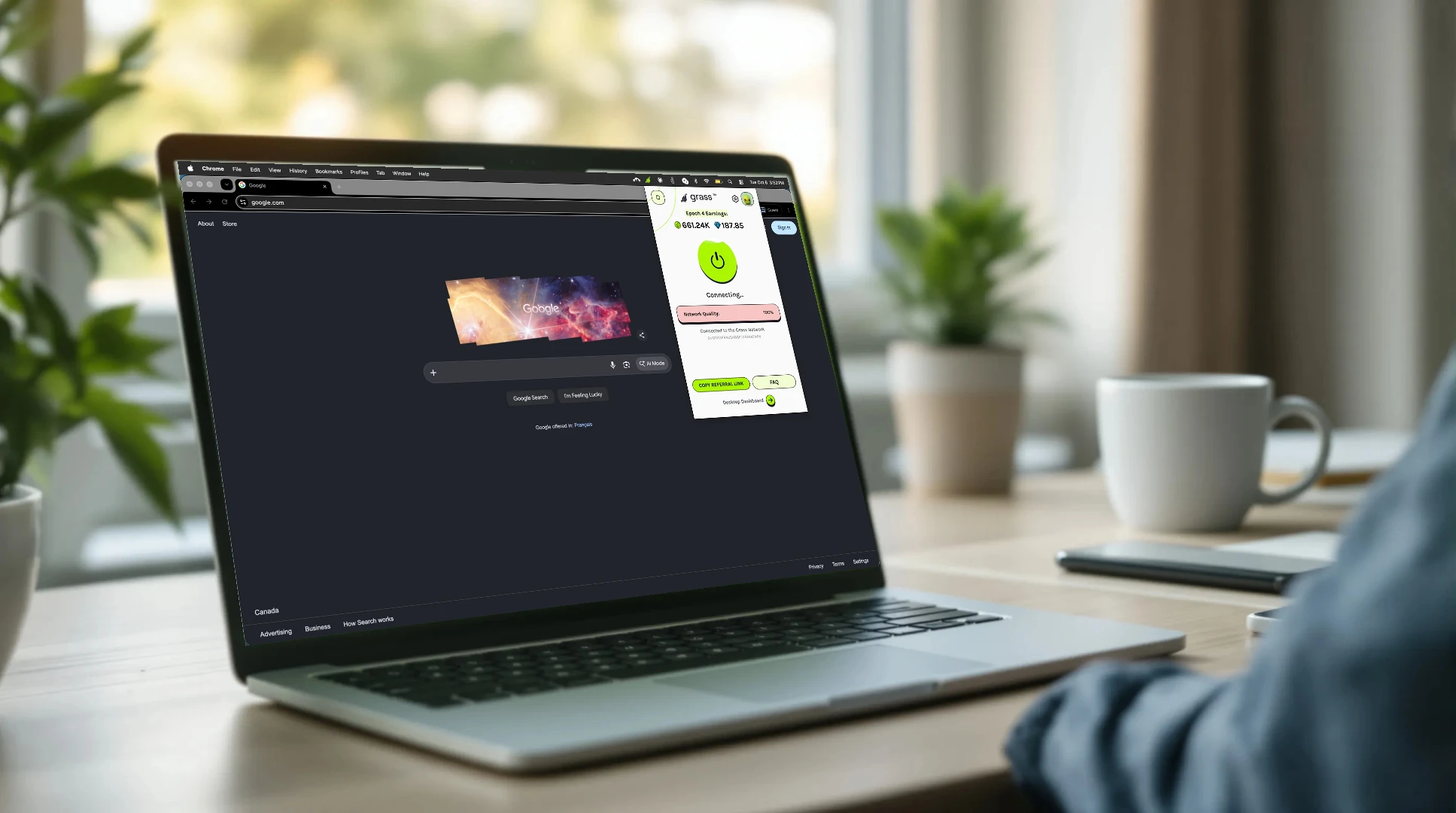
Grass is the bandwidth sharing example in this article. It runs quietly in the background on your own device and home connection.
Key terms
Bandwidth sharing: the practice of contributing unused internet connection capacity to a network in exchange for the opportunity to receive rewards.
Uptime Points: Grass Points earned for staying connected, as well as for referrals that meet the active-referral requirements.
Network Points: Grass Points earned when your bandwidth is actively used to power web data requests.
Node: the term for a device running Grass on the network.
Screen-out: a disqualification partway through a survey, usually after screening questions.
Where does bandwidth sharing fit on the side-hustle effort scale?
Bandwidth sharing sits at the zero-session-effort end of the reward app spectrum. You install Grass (the app) once, and it accumulates Uptime Points in the background while you do everything else.
The contribution is the running app itself - not a task you perform each time. In my experience, the setup-vs-session test is the clearest frame for comparing reward apps: separate the one-time cost to get started from the recurring cost you take on every time you want to get rewarded. Most reward apps make setup fast but keep session cost high - surveys, cashback platforms, and microtask tools all require you to show up and do something before credits accumulate. Bandwidth sharing inverts this: a few minutes to install, then a session cost of zero from that point forward.
A common misconception is that all reward apps in this category work roughly the same way. The reality is more precise. Bandwidth sharing requires nothing after the initial install. Surveys require your time and attention, on repeat, indefinitely. One model uses your unused internet connection; the other uses your attention - and those are very different resources.
What affects rewards in bandwidth sharing?
Rewards aren't guaranteed. Points measure your contribution to the network and help determine the rewards you may receive. Four factors shape how that contribution adds up:
- Uptime. Uptime Points track connected time, so launching the app at startup, rather than opening it manually, captures more connected time.
- Network demand. Network Points depend on demand for web data requests, and they can vary week to week even when uptime stays the same.
- Connection type. Bandwidth sharing runs on an everyday home internet connection. VPN and datacenter connections aren't supported.
- Multiple devices on one network. Devices on the same home network share rewards rather than being counted separately.
Reward rates are set per stage and announced by the Grass Foundation at distribution. Rewards are distributed at the end of each stage, so follow official Grass announcements for timing.
Why do surveys take more time than they seem?
Screeners ask roughly two to fifteen questions before deciding whether you fit the target group. If you don't qualify, many platforms record nothing for the time you spent.
Fit depends on demographics, and it shifts over time. Some platforms give partial credit when a screener disqualifies you, and others set minimum thresholds before you can redeem anything, which adds waiting time.
What does a typical week look like before and after adding bandwidth sharing?
Adding bandwidth sharing doesn't replace surveys. It fills the gap between them and keeps tracking your contribution while the device sits idle.
Before
Before: surveys only
- Answer screeners - disqualify - restart
- Complete one survey for a variable reward
- Nothing counts during downtime or overnight hours
- Weekly total depends entirely on demographic availability
After
After: bandwidth sharing added
- Grass (the app) accumulates Uptime Points in the background, continuously
- Network Points accumulate when the connection routes verified institution requests
- Surveys add active-session rewards on top of the background baseline
- Overnight, the node keeps tracking your contribution without any action required
Grass documentation reports that Uptime Points and Network Points each track a distinct contribution type - time connected versus bandwidth actively used. The practical effect: the background total keeps accumulating on days when no survey gets completed.
What can go wrong with bandwidth sharing after you've set it up?
Bandwidth sharing is not maintenance-free in every scenario. Connection type, demand variability, and shared home networks each create occasional friction - though none require the session-by-session engagement that surveys demand.
The most common disruption across bandwidth-sharing apps is connection type. Most require an everyday home internet connection - one that identifies to the web as a home user rather than a server. If a user runs a VPN, or if their ISP routes them through a datacenter-type connection, the bandwidth sharing app stops accumulating rewards. This happens silently: the app continues running, but nothing counts. Grass documentation reports that a network quality score of 0% indicates the connection is not eligible for rewards. VPN and datacenter connections aren't supported.
The VPN limit affects users who rely on VPN services for other purposes. Bandwidth-sharing apps do not penalize VPN use - VPN and datacenter connections aren't supported, so no traffic is routed through them. Users who need both can run bandwidth sharing and VPN services on separate devices, or toggle the VPN off when they want the sharing app to accumulate rewards.
Demand variability is a second factor that app marketing often underplays. The volume of traffic routed through a node depends on what verified institutions are requesting at a given time, not on how much bandwidth the user makes available. Users can see significant fluctuations in weekly Network Points even when uptime stays consistent - because demand in their region naturally varies.
Multiple devices on the same home network create another limitation. Grass documentation states that multiple devices on the same home network share rewards rather than being counted separately. Running three devices through one router does not triple the reward. What this means in practice: one consistently connected node on a stable everyday home internet connection tends to outperform a cluster of nodes sharing the same connection.
Points on your dashboard can temporarily disappear while the daily calculation runs, which typically takes 12-24 hours. They return once it finishes.
Bandwidth sharing vs. surveys - which is easier to get rewarded with?
For a user choosing based on effort, bandwidth sharing is the lower-effort option. Setup is one-time; surveys require session participation indefinitely.
The comparison comes down to which resource each option consumes. Surveys require attention - a resource that is scarce and non-renewable during a busy day. Bandwidth sharing uses unused internet connection capacity that would sit idle regardless of whether an app is running. An unused connection sitting idle and the same connection running Grass (the app) are functionally identical from the user's perspective. The difference is the points that accumulate in the background.
A practical starting point: install Grass (the app) on a device with a stable home internet connection and let it run. Add a survey platform as a supplementary layer for moments when attention is genuinely available - waiting in a queue, riding transit, or sitting between tasks. The two options draw on different resources and can run in parallel without competing for either. Bandwidth sharing keeps running in the background; survey rewards come from active participation. Together, they cover both modes without one crowding out the other.
Key Takeaways
- Bandwidth sharing accumulates points from uptime and network activity. No session time is required after setup.
- Survey rewards depend on eligibility; time spent on surveys that disqualify you usually doesn't count.
- Bandwidth sharing runs on an everyday home internet connection. VPN and datacenter connections aren't supported.
- Running both methods simultaneously is viable. They draw on different resources.
- Rewards aren't guaranteed. Points help determine the rewards you may receive.
Will bandwidth sharing stay the easier option over time?
Yes. The effort comparison between bandwidth sharing and surveys is unlikely to shift in the near term: one method keeps running in the background, and one does not.
That structural difference - not the reward rates - is what most users find decisive after a few months with both.
Grass documentation notes that the Grass network carries AppEsteem certification, which means continuous independent monitoring for vulnerabilities, leaks, and malware. That certification matters because the main barrier to installing a background app is usually security concern, not reward size.
Grass routes web requests through your unused bandwidth and does not access the information on your computer, your browsing history, or your private files.
The verdict
Should you choose bandwidth sharing, surveys, or both?
The right choice depends on one factor: whether the user wants to get rewarded for time they are already spending, or for connection capacity that is already available.
Both approaches work. The difference is which idle resource they tap.
Choose bandwidth sharing if:
- Your primary goal is getting rewarded without session time. Bandwidth sharing requires no active input after the initial setup.
- Your device connects through an everyday home internet connection. Grass documentation specifies that VPN and datacenter connections aren't supported.
- You find survey screen-outs and disqualifications frustrating. Bandwidth sharing has no equivalent rejection mechanism.
Choose surveys if:
- You use a VPN consistently. Survey platforms work with any connection type; bandwidth sharing does not.
- You prefer active tasks with a defined start and end per session.
- You need flexibility across multiple devices. Bandwidth sharing limits participation to one account per person.
Consider running both if:
- You already participate in surveys and want a background layer that keeps running during idle time. The two methods do not compete for the same resource: surveys use your attention; bandwidth sharing uses unused internet connection capacity.
Frequently asked questions
Yes. The two methods use different resources. Bandwidth sharing draws on unused capacity in your internet connection; surveys draw on your time and attention. Running both simultaneously does not reduce the performance of either.
Typically not. Bandwidth sharing apps draw on connection capacity that goes unused during normal activity. Users on lower-speed plans may notice more impact than those on faster connections, though most report no noticeable difference.
Grass routes web requests through your unused bandwidth and does not access the information on your computer, your browsing history, or your private files. It collects only limited personal data tied to operating your account, as described in its Privacy Policy, and the app is certified by AppEsteem.
Network Points - the points tied to active bandwidth use - depend on institutional demand, which fluctuates. Consistent uptime does not guarantee consistent weekly totals. This variability is a feature of demand-based rewards rather than a problem with the app.
Screen-outs - disqualifications after starting a survey - are the most widely cited frustration. Bandwidth sharing has no equivalent rejection mechanism.
Survey platforms commonly impose minimum thresholds before cashout is available. Bandwidth sharing platforms vary in their policies. The practical difference is that bandwidth sharing rewards accumulate automatically, while survey rewards only accumulate when you complete qualifying sessions.
Create a username, enter your email and set a password, then download the app, log in and let it run. You must be 18 or older, and each person can have one account.
Grass runs as a browser extension and desktop app, and it is available on Android. Check the official Grass documentation for current supported system versions before installing, since 32-bit systems aren't supported.
Uptime Points track how long your node stays connected and available. Network Points track when your bandwidth is actively used for web data requests. Together they measure your contribution and help determine the rewards you may receive.
No. Rewards are distributed at the end of each stage rather than after every epoch. Follow official Grass announcements for timing and eligibility.
Written by
Maya Ellis
Contributor Education Writer
Maya Ellis writes Grass's getting-started and trust-and-safety guides.
Follow on XSummarize This Article With AI
Open this article in your preferred AI engine for an instant summary.