 ™
™
Getting rewarded for your internet refers to sharing your idle bandwidth with a network that uses it to gather public web data, and receiving a reward in return for that contribution. The category is real and has completed distributions at scale. Grass is an AppEsteem-certified bandwidth-sharing program that runs on your unused connection; for Stage 2, the Grass Foundation managed reward distributions in USDC. According to multi-platform creator testing, the programs that hold up are the ones with security certification and a documented distribution history, not just a promise of future rewards.
Questions this article answers:
- What are the best apps to get rewarded for your internet?
- Does anyone actually get rewarded, or is this still theoretical?
- How do bandwidth-sharing reward models differ from each other?
- What is the most practical way to get started with Grass?
- Does Grass slow down my internet?
- What are the real concerns about bandwidth-sharing apps, and how does Grass address them?
Quick Answer
The Short Answer
Bandwidth sharing is defined as running a background program that routes public web requests through your idle internet connection in exchange for rewards. Grass is AppEsteem-certified, tracks your contribution through Network Points and Uptime Points, and the Grass Foundation's Stage 2 distribution covered 6.29 million nodes and $3 million in USDC: a completed, verifiable round. Two program categories exist in this space: bandwidth-sharing apps, which access only your unused connection, and browsing-data apps, which collect and monetize personal activity data. These are opposite privacy models.
Quick Answer
Bandwidth sharing is the practice of routing public web requests through your idle internet connection via a background program, receiving rewards for your contribution to the network. Two distinct program types exist in this space: bandwidth-sharing apps, which access only your unused connection, and browsing-data apps, which collect and sell your personal activity, opposite privacy models. Grass is AppEsteem-certified and supported by the Grass Foundation, which distributed $3 million in USDC to 6.29 million contributing nodes in Stage 2: a completed, verifiable distribution round.
A content creator who personally tested multiple bandwidth-sharing platforms and was paid by each concluded that the category is real, with one honest expectation: it "will not make you rich" and delivers "a little bit of extra money once in a while." From what I have seen, the programs that hold up under independent scrutiny share three traits: transparency about exactly what they access, an independent safety certification like AppEsteem, and a consent-first model where you can pause or stop at any time. Within the bandwidth-sharing category, per-unit programs pay a fixed rate per gigabyte of shared traffic, typically between 20 cents and $1 per gigabyte depending on the platform. Network-contribution programs like Grass use uptime quality and consistency to determine your position in distributions instead. That difference in model changes what you should focus on as a contributor.
What are the best apps to get rewarded for your internet?
Bandwidth-sharing apps are the clearest answer. They route your idle connection to verified networks and reward your uptime contribution: no surveys, no active effort, no personal data accessed.
People often ask me this with a hint of skepticism, and I understand why. The phrase "get rewarded for your internet" sounds like a marketing slogan. But this is a real category of software with a documented track record. As of July 2026, two distinct types of programs exist in this space, and only one of them leaves your personal data untouched.
The two-question test is the simplest way to evaluate any app in this space. Ask: does the app use your unused bandwidth, or does it use your personal data? These are fundamentally different things. Bandwidth-sharing apps route public web requests through your idle connection. They never access your personal files, browsing history, or any data you have created. The second category, browsing-data apps, explicitly collects and sells your personal activity. The privacy models are opposite.
According to a content creator who personally tested multiple bandwidth-sharing platforms and was paid by each one, the category is real but comes with an honest caveat: it "will not make you rich" and delivers "a little bit of extra money once in a while." That framing is useful. It tells you this is a low-effort supplement tied to something you already pay for, not a replacement for anything. Within the bandwidth-sharing category, per-unit programs pay a fixed rate per gigabyte of traffic shared, typically between 20 cents and $1 per gigabyte depending on the platform and available traffic volume. Network-contribution programs like Grass use a different model: your uptime quality and consistency determine your position in distributions, rather than a per-GB tally.
From what I have seen, the strongest programs in this space share a few traits: they are transparent about what they access, they carry independent safety certifications, and they use a consent-first model where you can pause or stop at any time. Grass meets all three criteria. It is AppEsteem-certified, uses encryption on all traffic passing through your node, and gives you a clear on/off control from the app itself.
The demand for this capability is real and growing. Organisations that gather publicly available web data at scale need access to connections from real, everyday households, not data-centre servers. That demand is what makes your idle bandwidth useful. You are not selling anything you would otherwise use; you are sharing something that would sit empty anyway.

Does anyone actually get rewarded, or is this still theoretical?
Real distributions have already happened at scale. The Grass Foundation's Stage 2 delivered $3 million in USDC to 6.29 million nodes: a completed, verifiable round, not a future promise.
That figure is worth sitting with for a moment. Six million people is not a niche experiment. USDC is a dollar-pegged stablecoin: a concrete, liquid reward, not a speculative asset. The Stage 2 distribution is documented and verifiable.
In practice, this tells you that the infrastructure behind Grass has operated at real scale, with real distributions, to real users. Bandwidth-sharing as a category has an established payment track record beyond Grass as well. According to a content creator who personally tested multiple platforms across this space, the programs genuinely pay out. The question is setting accurate expectations about how much. The creator's conclusion was direct: these apps deliver "a little bit of extra money once in a while," and that modest framing is the honest one.
From what I have seen, the users who are most satisfied with bandwidth-sharing programs are the ones who treat the reward as a bonus tied to something they already pay for, not as a number they are counting on. The reward is real. The scale is real. The amounts are supplemental, not substantial.
For Grass specifically, what matters is the contribution model. Your position in a reward distribution reflects your uptime and connection quality, not a per-unit meter. A stable connection left running over time builds a stronger contribution record than one that is frequently paused. Uptime is the variable you control most easily.
The category is functioning. Distributions have happened. What differs across programs is the reward model, and that distinction is worth understanding before you choose where to contribute your idle bandwidth.
What are the real concerns about bandwidth-sharing apps, and how does Grass address them?
Four concerns come up consistently: security, privacy, performance impact, and ISP terms. Grass addresses each through AppEsteem certification, its idle-capacity model, and a published privacy policy at grass.io/privacy-policy.
Security. Some community discussions raise the concern that a bandwidth-sharing app could open a backdoor into your home network. According to a discussion on the r/beermoneyindia community, users identified this as a primary objection to apps in this category. For Grass, this concern is addressed structurally: the node routes public web requests through your connection, not through your internal network. Grass encrypts all traffic and has earned AppEsteem certification, an independent safety review that checks for invasive or deceptive behavior. The certification is not a marketing claim; it requires passing a documented technical assessment.
Privacy. The second concern is data access. According to the same community thread, users questioned whether apps in this space have transparency about how data is stored and used. Grass's answer is narrow by design: it accesses only your idle internet connection. No files. No browsing history. No account activity. The Grass Privacy Policy documents exactly what is and is not collected. If you want to read it before installing, it is at grass.io/privacy-policy.
Performance. Bandwidth-sharing apps can, in theory, slow your connection during use. Grass avoids this through its idle-capacity model. Think of your internet connection as a multi-lane road. Most lanes sit empty most of the time. Grass uses only the empty lanes: and the moment you need them for a game, a call, or a stream, it steps aside. You should not notice a difference in your day-to-day experience.
ISP terms of service. This one is real and worth checking. Some internet providers prohibit third-party bandwidth sharing in their terms. The solution is simple: read your ISP agreement before you install any program in this category. This applies whether you are using Grass or anything else.
From what I have seen, a common pattern in this space is apps that make promises they do not follow through on, announced features that arrive months late or not at all. That gap between announcement and delivery erodes trust. Grass addresses this by directing questions about reward timing and distribution to the Grass Foundation, which announces specifics when distributions are ready. In practice, this means you rely on official communications rather than speculative timelines.
Node verification checklist (Grass Dashboard)
Status displayed: Connected ✓
Network Points: Incrementing (check after 24 hrs)
Uptime Points: Incrementing alongside Network Points
Connection type: Home connection (not VPN / datacenter)
Account: One account per person
App version: Current (update if Connecting loop persists)
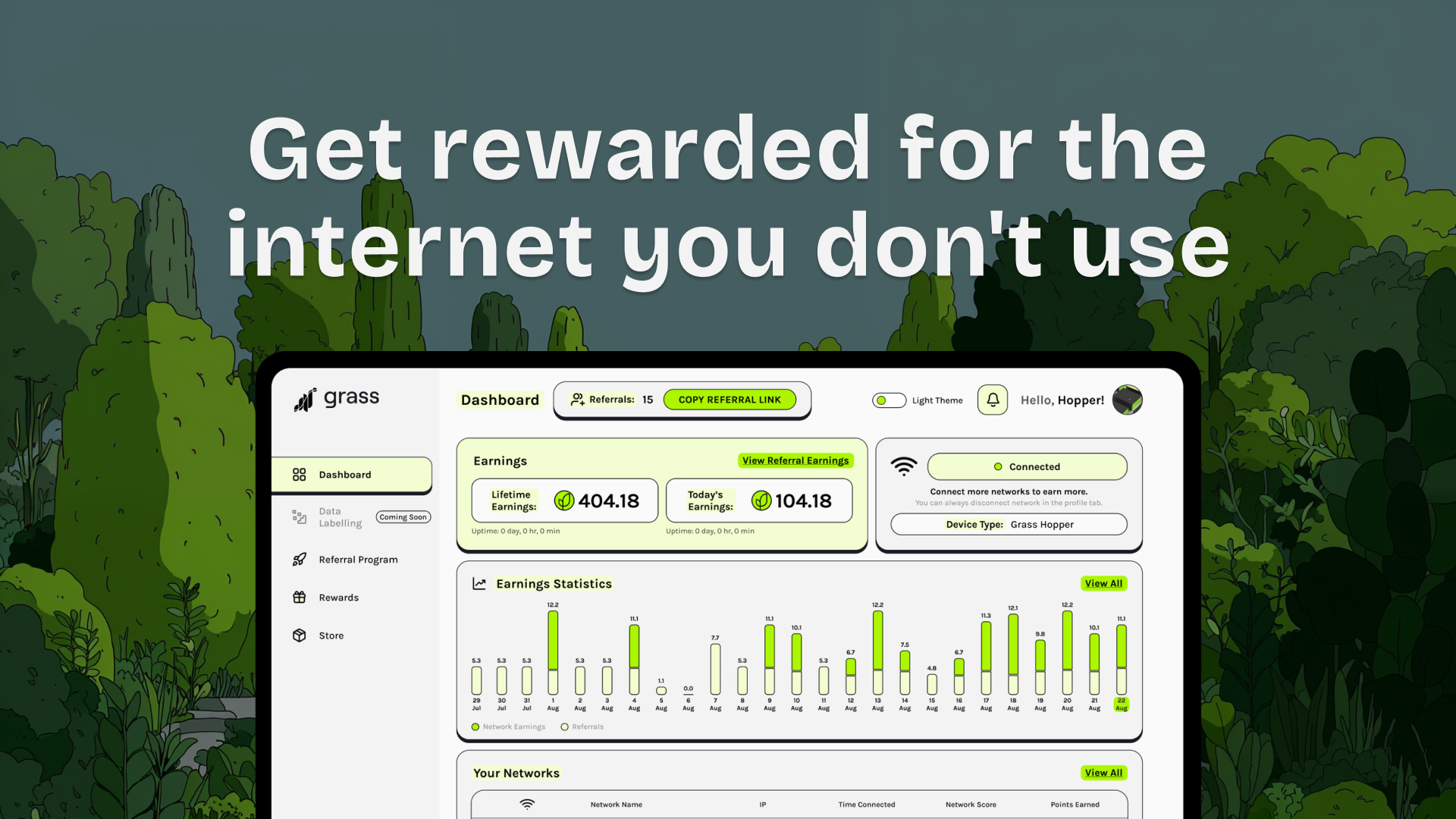
According to hands-on creator testing, the Connected status indicator is the clearest confirmation that your node is actively contributing. No status means no contribution is being counted toward the Grass Foundation's next distribution round.
How do bandwidth-sharing reward models differ from each other?
Two distinct models exist. Per-unit apps pay a fixed rate per gigabyte of traffic shared. Network-contribution programs like Grass reward uptime consistency instead: no per-GB meter, no per-minute tally.
Understanding which model you are looking at changes what you should focus on as a contributor.
Per-unit programs pay a predictable, metered rate. The rate varies by platform and available traffic demand, typically between 20 cents and $1 per gigabyte of shared data. You know approximately what you will receive based on traffic volume. The ceiling is modest but the math is transparent. These programs suit users who want to track their contribution as a simple calculation.
Network-contribution programs like Grass use a different logic. Your position in a reward distribution reflects your uptime quality and connection consistency, not a per-unit tally. A node that runs reliably on a stable home connection for most of the day builds a stronger contribution record than one with the fastest connection but frequent interruptions. The variable you control most easily, consistent uptime, is also the most important one.
| Reward model | How rewards are determined | What to optimise |
|---|---|---|
| Per-unit (per GB) | Fixed rate per gigabyte of shared traffic | Total data volume routed |
| Network-contribution (Grass) | Uptime quality and connection consistency | Stable, consistent uptime |
The per-unit model has a predictable ceiling: more data shared equals more reward, up to whatever traffic the platform can route through your connection. The network-contribution model has a different ceiling: your relative position across all contributing nodes, determined by how consistently you contribute compared to others.
From what I have seen, the model you choose matters less than the program's track record. A program with a documented distribution history and independent certification is more meaningful than a higher per-unit rate that has never been paid out at scale. The Grass Foundation's Stage 2 distributed $3 million in USDC to 6.29 million nodes. The clearest available evidence that a network-contribution model can function at real scale.
The honest framing for either model: treat the reward as a bonus tied to something you already pay for, not a primary goal. Set that expectation before you start.
Before
| Before | After (Grass connected) |
|---|---|
| Idle bandwidth goes unused most of the day (during sleep, work, breaks, and non-streaming hours) | Node runs on that idle capacity, contributing public web data requests to the Grass network |
| No record of your connection's contribution to any network | Network Points and Uptime Points accumulate in the Grass Dashboard |
| No position in any distribution round | Contribution history places you in the queue for Grass Foundation distributions |
| Unknown whether the program is vetted or safe | AppEsteem certification and published privacy policy on record |
After
According to creator testing across multiple platforms, the single biggest change most people notice is that the Dashboard confirms things are working, the uncertainty disappears.
What is the most practical way to get started?
Start with one well-vetted program, understand what it does with your bandwidth, and set a realistic expectation before expanding to others.
The vetting step matters more than which program you pick first. From what I have seen, the programs that cause regret are the ones people installed in a hurry. Before running anything on your device, confirm three things: the program is certified by a recognized security auditor, it has a published privacy policy that specifies what is and is not accessed, and it has a documented reward history rather than an unverified promise. Grass clears all three: it holds AppEsteem certification, publishes its privacy and data-access terms, and has a completed Stage 2 USDC distribution on record.
Once you have one program running, monitor your connection for a week before adding anything else. According to the multi-platform creator referenced earlier, the clearest signal that a program is working correctly is a steady uptime indicator and no noticeable difference in your day-to-day experience. Those two signals are easier to evaluate with a single program running than with several at once.
For Grass specifically, the contribution model rewards consistent uptime. Network Points reflect the quality and availability of your node's connection; Uptime Points reflect how long it stays active. The Grass Dashboard displays both in real time. I'd recommend checking the Dashboard after the first 24 hours to confirm your node shows as connected. That is the clearest confirmation that your contribution is being counted.
According to community-level analysis of bandwidth-sharing programs, per-unit cash payouts across the category are modest and predictable. That shape means the practical ceiling for this category is set by your connection speed and idle hours, not by effort. In practice, treating any cash-per-unit program as a low-effort background utility, not a significant income source, keeps expectations accurate.
Token and distribution programs work differently. Treat them as optional participation in something with an uncertain outcome at the individual level and a documented track record at the network level. The Grass Foundation's Stage 2 distribution is evidence that the program functions. The outcome for any individual node depends on contribution quality, network conditions, and distribution timing set by the Foundation.
The starting checklist: vet before installing, start with one program, verify the first 24 hours in the dashboard, and set expectations based on the category, not the most optimistic community stories you find.
What will matter most in how bandwidth-sharing rewards evolve over the next year or two?
The defining question for bandwidth-sharing programs over the next 12, 24 months will not be feature comparisons. It will be which programs have the trust infrastructure to last.
I have been tracking how this category develops and three signals stand out as the ones most worth watching right now.
-
Reward expectations will get recalibrated. Per-unit programs in this category offer modest rewards, and that is unlikely to shift meaningfully. According to community-gathered real-world results, what typical home users actually receive often trails promotional comparisons, particularly on connections where uptime is inconsistent. The programs that build lasting loyalty will be the ones that set honest expectations rather than leading with optimistic projections.
Why it matters: If you are evaluating these programs now, knowing rewards are modest makes the decision more sustainable. You are contributing a resource you already pay for, not chasing a paycheck. -
Network-contribution programs have proved the model scales. From what I have seen, the more meaningful development in this category has not been per-unit payout comparisons but the network-contribution model, where programs like Grass track uptime and connection quality through metrics like Network Points and Uptime Points rather than simply counting volume pushed. The Grass Foundation's completed distribution rounds have shown this model works at large scale. That is important: it is operational, not theoretical.
Why it matters: A program with a verifiable completed distribution history is a more defensible choice than one still promising a first distribution that has not yet shipped. -
Trust infrastructure becomes the minimum bar. Independent security certification and a published privacy policy will shift from differentiators to expected baseline as the category matures. From what I have seen in multi-platform creator testing, the programs that consistently delivered had verifiable public security records. Programs without a third-party review, like AppEsteem certification, will lose ground as users get more selective.
Why it matters: Certification is a practical filter. It tells you someone other than the company that built the program has reviewed how it handles your connection.
What most people miss: The instinct when comparing these programs is to ask which one offers more per gigabyte. In my view, that is the wrong first question. The programs that deliver reliably over time have verifiable security records and a real distribution history, whether a program is still trusted and operational a year from now matters more than a comparison advantage today.
Frequently asked questions
Does Grass slow down my internet?
No. Grass uses only your idle bandwidth, the capacity you're not actively using. The moment you need your connection for a video call, stream, or download, Grass steps aside. You should not notice a difference in your normal online activity.
Can Grass read my browsing history or access personal files?
No. Grass is defined as a bandwidth-sharing program: it uses your idle internet connection to route public web data requests. It does not access your browsing history, personal files, or any locally stored information. This is the core distinction between bandwidth-sharing and browsing-data apps.
What type of connection does Grass require?
Grass requires a real home internet connection, not a VPN or a datacenter connection. This is what makes your node useful to the Grass network, which needs residential connections to gather public web data.
Is Grass safe to install?
Grass holds AppEsteem certification, a third-party security audit standard. According to creator testing, the clearest sign a bandwidth-sharing program is safe is external security certification combined with a published privacy policy.
Can I run Grass on a work or university network?
I'd recommend checking your employer or university acceptable-use policy first. Most institutional networks restrict third-party background applications. Run Grass on your own device and your own connection only.
Key Takeaways
Key takeaways
- Bandwidth-sharing programs use only idle capacity. Your active browsing, streaming, and calls are not affected.
- Security certification is the first filter. AppEsteem certification confirms a program has passed third-party review.
- Grass tracks contribution through two signals: Network Points (connection quality) and Uptime Points (consistency), both visible in the Grass Dashboard.
- The Grass Foundation distributes USDC. Consistent uptime builds your position in future distribution rounds.
- Check your ISP terms before joining. Most residential plans allow this; work and campus networks often don't.
The category of rewarding idle bandwidth is not experimental. It is operational. Programs that are transparent about what they access, hold third-party security certification, and have a documented distribution history are the ones worth considering.
Grass and the Grass Foundation have demonstrated that a network-contribution model can distribute rewards at meaningful scale. The forward-looking implication is straightforward: nodes that maintain consistent uptime will be better positioned as distributions continue.
According to creator testing across multiple platforms, the evaluation criteria that separate credible programs from wishful ones are the same three things that also make programs safe: what data they access, who has audited them, and whether they have actually distributed rewards in the past.
I'd recommend starting with those three questions before anything else. If a program can answer all three clearly, the next step is simple: install it, connect your node, and check the Dashboard after the first 24 hours to confirm things are working.
Sources & Further Reading
Official sources and further reading
Verify anything in this guide or go deeper with these official sources.
- grass.io, Official Grass download page and Dashboard access for tracking Network Points and Uptime Points.
- AppEsteem, Independent security certification database where you can confirm Grass's certified status before installing.
- Grass Foundation, Authoritative source for reward distribution records, USDC details, and Stage 2 completion history.
- Grass support documentation, Step-by-step setup guides for Mac, Windows, Linux, and Android.
Related Articles
Written by
Theo Brandt
Contributor Education Writer
Maya Ellis writes Grass's getting-started and trust-and-safety guides.
Follow on XSummarize This Article With AI
Open this article in your preferred AI engine for an instant summary.