 ™
™
Grass refers to a DePIN (Decentralized Physical Infrastructure Network) application that routes publicly accessible web data through the portion of your internet connection you are not actively using. It never accesses personal files, passwords, or browsing history. Available for Windows, Mac, Linux, and Android, Grass accumulates Grass Points automatically while it runs - at official reward distributions, your points determine your reward - for Stage 2, paid in USDC on the Solana blockchain.
Quick Answer
The short answer: Grass is a DePIN node application that routes publicly accessible web data through the idle portion of your internet bandwidth - the capacity your household is not actively using. It does not access personal files, passwords, or browsing history. Grass Points accumulate automatically and determine your reward at official distribution events - for Stage 2, paid in USDC on the Solana blockchain.
People often ask what Grass actually does with their connection. The short answer is: it borrows only the bandwidth you are not using and routes it to companies that need to retrieve publicly accessible web data - price feeds, market research, publicly listed content. Grass is a node application, meaning your device becomes a small part of a larger network. It never reaches private files, passwords, or browsing sessions.
Setup is straightforward. You download the app, connect it, and it runs silently. There is no ongoing task requirement. Grass Points accumulate automatically and determine your reward at official distribution events (Stage 2 rewards are paid in USDC). The platform is available across desktop operating systems and Android. Contrast that with task-based platforms, where rewards require active daily engagement - a genuinely different category of app.
Is Grass Worth It in 2026?
As of August 2026, Grass is worth running if you want a genuinely zero-effort way to put idle bandwidth to work - but the answer depends on what you expect to get out of it.
People often ask me whether Grass is still relevant now that crypto enthusiasm has cooled in some corners of the internet. From what I have seen, the question itself tells you something: most people asking it are not skeptics - they are curious. They heard about bandwidth-sharing from a friend, saw the app mentioned in a forum, and want to know if it is real before they commit five minutes to setting it up.
Here is the honest frame I use - call it the effort-versus-expectation test. Ask yourself two things before installing any rewards app: How much active time does it require? And what is the realistic monthly reward? With Grass, the first answer is effectively zero - the app runs silently in the background and steps aside when you need your connection. The second answer is more nuanced, and I will cover it in detail later in this article.
The contrarian view worth naming: Grass is not a primary income source. A common misconception is that bandwidth-sharing apps replace a real paycheck. They do not. What Grass actually offers is a background reward for something you have already paid for and are not using - your idle internet capacity.
What Does Grass Actually Do With My Internet Connection?
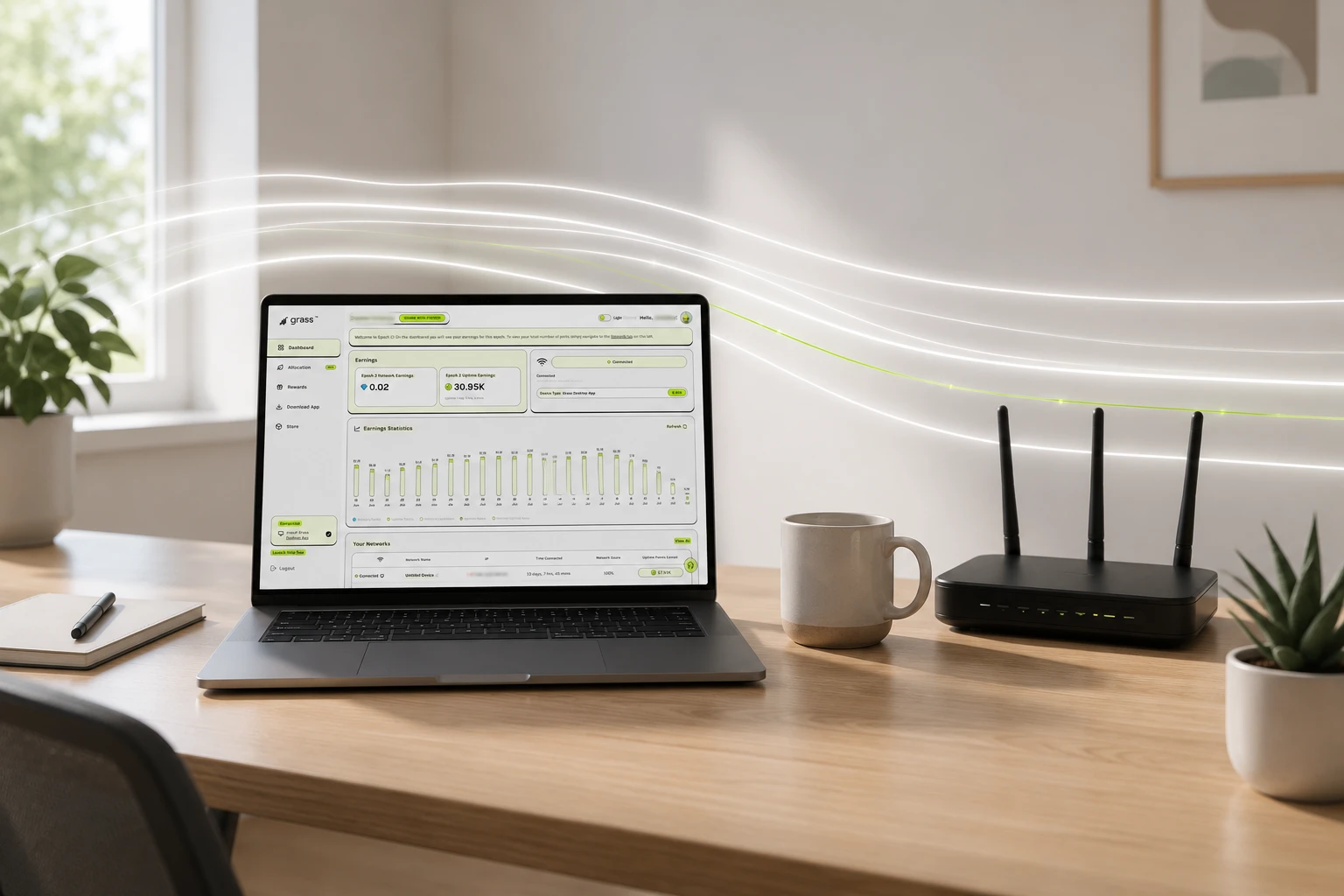
Grass borrows only the idle portion of your bandwidth and uses it to help verified institutions retrieve publicly accessible web data. Your active traffic - streaming, downloads, video calls - always takes priority.
Here's what's actually happening at the network level. Your home internet plan provides more capacity than you use at any given moment. Think of it like a six-lane road where you're typically driving in one or two lanes. Grass uses the empty lanes. The moment you merge into a third or fourth - say, a 4K video starts buffering or a large download kicks off - Grass yields automatically. You don't need to intervene.
The data flowing through your node is limited to public web routes. The businesses and researchers on the Grass network use those routes to retrieve information from websites that are openly accessible to any browser - the same type of requests a regular visitor would make. What Grass does not do is touch any traffic tied to your accounts, your passwords, your emails, or anything stored on your device. Those never enter the picture.
And it's not just text. The public web today is images, audio, and video as much as it is articles and prices - and that's exactly the kind of multimodal data modern AI models are built on. So the requests moving through your connection increasingly help gather that fuller picture of the open web: a publicly listed product photo, a publicly posted video, a page of public listings. Still public, still nothing tied to you - just a broader slice of what's already out there for anyone to see.
In practice, this means two things. First, your personal data is structurally separated from the network traffic. Second, the requests traveling through your IP are for public data - not for anything requiring authentication or personal access.
Where I've seen people get confused is with the word "bandwidth." Many assume that handing over bandwidth means handing over data. The distinction is architectural: bandwidth is the road; your data is the cargo in your own truck. Grass only borrows road access. What you're carrying stays locked.
Where this is heading. Right now, most of that public data helps train AI models after the fact. But the network is moving toward something more real-time. Grass is developing what it calls Live Context Retrieval (LCR) - the ability to pull fresh, up-to-the-moment public web context for AI systems, rather than only feeding them data later. If that direction plays out, your idle bandwidth won't just help train tomorrow's models - it'll help answer questions using what's on the public web right now. The privacy math doesn't change either way: still public data, still nothing personal to you.
The zero-effort profile is what sets Grass apart from task-based reward apps. Active-engagement apps reward time and effort; Grass rewards presence. The two aren't really competing - they serve different situations.
How Do Grass Points and Rewards Actually Work?
Grass Points aren't a currency and they aren't a wallet balance - they're a record of how much you've contributed to the network. There are two kinds. Network Points are earned when your bandwidth is actually used by the network. Uptime Points are earned for staying connected, and reflect your connection quality, your location, and bonuses like referrals.
This is the part that trips up most new users, and I understand why. The dashboard shows a growing points balance, which can look like money in an account. It isn't - points measure your contribution, and they're what your reward is calculated from at the end of a stage.
The form of the reward is set for each stage. For Stage 2, rewards are being distributed in USDC (a stablecoin) rather than in GRASS tokens - which lets participants in eligible regions claim quickly and compliantly. It's worth knowing these rewards are funded by the network's revenue, not by minting new tokens: the distribution adds no new GRASS and doesn't change the token's supply, and whether or not you hold GRASS has no bearing on what you receive. Your allocation is calculated purely from your contribution, weighted most heavily by how much of your bandwidth the network actually used.
One practical tip from the network's own data: your device matters. Android has earned the most rewards, followed by desktop, then the Chrome extension - and a stable connection on a residential network (not a VPN), kept up to date, gets prioritized.
Claiming. Grass provides an in-app, non-custodial wallet on your dashboard, so you don't need to be crypto-native to receive your rewards - your USDC lands there once you claim. Because the claim happens on-chain, it can involve a small Solana network fee (and, if you use the in-app wallet, a small wallet fee); Grass doesn't earn anything from those. Always claim only through the official Grass dashboard - Grass will never DM you first or ask for your seed phrase or private keys.
For exact eligibility, reward rates, claim dates, and terms, the authoritative source is the official Stage 2 rewards details on the Grass dashboard - always go there, not third-party sites.
Are There Apps That Pay You for Unused WiFi or Internet?
Yes - and they split into two distinct models: bandwidth-sharing apps that run silently in the background, and task-based reward apps that require your active time. Grass falls in the first category.
The difference matters more than people realize when they are shopping for the right fit. Here is how the two models compare:
| Feature | Grass (bandwidth-sharing) | Task-based apps |
|---|---|---|
| What you contribute | Unused bandwidth | Active time (surveys, games) |
| Effort required | None after setup | Daily engagement required |
| Reward form | Grass tokens (Stage1) Rewards paid in USDC (Stage 2) |
Cash, gift cards, PayPal |
| How rewards are determined | Your network contribution - connection quality, location, and how much bandwidth the network actually uses | Number of tasks you complete |
| Wallet needed | No - Grass provides an in-app, non-custodial wallet | Platform account |
| Geographic availability | Broad international | Varies by platform |
The people who get the most from Grass are those who want genuinely zero-effort participation - a node that runs quietly in the background and rewards them for the bandwidth they share, without any task completion. The people who get more from task-based platforms are those willing to invest daily engagement in exchange for cash-equivalent rewards.
In practice, these are not mutually exclusive. Running Grass alongside a task-based app is a common approach: Grass runs in the background while you are away, and you complete surveys or offers when you have a few spare minutes. The resource inputs are different, so they do not compete with each other.
One structural difference worth naming: Grass rewards are distributed on-chain rather than paid straight to a bank account or PayPal, so there's a claim step involved. For Stage 2, those rewards come as USDC - a stablecoin pegged to the US dollar - and Grass provides an in-app, non-custodial wallet to make claiming straightforward even if you've never used crypto. It's worth understanding that flow before you start, not after.
Is Bandwidth Sharing Safe? What to Watch Out For in 2026
Bandwidth sharing through Grass is legitimate - but the ecosystem around crypto rewards attracts impersonators. Knowing how to tell the real platform from a fake one is essential before connecting any wallet.
Here is the specific threat pattern I want you to be aware of. Security researchers have identified phishing sites that impersonate the Grass network - including domains like claim-grassfoundation.pages[.]dev and grass-foundations.pages[.]dev - designed to harvest cryptocurrency wallet credentials. These sites mimic the look of the official Grass claim portal closely enough to fool users who are not paying attention to the URL.
The attack works like this: you arrive at the fake site (often via social media or a compromised link), attempt to connect your wallet, an error appears, and you are then asked to "connect manually" by entering your wallet's passphrase or seed phrase. No legitimate platform will ever ask for your seed phrase. If you see that prompt, leave immediately.
According to PCRisk security researchers, the FTC has documented that since 2021, more than 46,000 people have reported losing over $1 billion in crypto to scams - roughly one in every four dollars lost to all reported scams. Crypto's irreversibility makes these losses permanent. There is no chargeback mechanism on the Solana network.
In practice, verifying you are on the real platform takes ten seconds:
- Use only grass.io - the official domain
- Never follow airdrop claim links from social media
- Bookmark the official site rather than searching for it each time
- Never enter a seed phrase or passphrase on any Grass-related site
The takeaway: the risk with Grass is not from the app itself. The risk is from bad actors using Grass's name to reach users who are excited about a legitimate reward claim.
How Can I Make the Most Out of Grass?
More uptime and more connected devices directly increase your Grass Points. There are a few practical moves that make a meaningful difference without any ongoing effort.
Run multiple devices simultaneously - on separate connections. Each device you run Grass on earns independently, but only if it is on a different internet connection. A phone on mobile data counts as a separate connection from your home WiFi. A laptop at a cafe uses a different network again. Each additional connection adds to your points.
The Android app is now available alongside the existing Mac, Linux, and Windows versions. At time of writing, running Grass on Android provides a rewards boost - a deliberate incentive from Grass to drive mobile adoption. In practice this means a smartphone running the Android app alongside your desktop setup can meaningfully increase your total points accumulation.
Keep both apps up to date - desktop and Android. This one is easy to overlook, but it matters more than most people expect: the network favors nodes running the latest version when it decides where to route traffic, so an out-of-date app can quietly earn less than a current one. Turn on automatic updates where you can - through the Play Store on Android, and through the app's own updater on desktop - and make a habit of confirming both your phone and your computer are on the newest release. It takes seconds, requires no ongoing effort, and keeps you in the pool the network reaches for first.
Grass has discussed a dedicated plug-in device ("Grasshopper"), but it is not proceeding to rollout at this time - so it isn't something to count on today. It is a standalone plug-in node - hardware you plug in and forget, with no phone or computer required. From what I have seen of the category, dedicated hardware for bandwidth-sharing is a genuine step forward: it removes the app-running overhead entirely and keeps the node online continuously without depending on a device that you might restart, close, or carry out of the house.
How much reward your points translate to isn't a fixed rate - it depends on your activity, the specific reward stage, your bandwidth usage, and your location. Two nodes with identical uptime can end up with different rewards. The takeaway is that consistent uptime over time matters more than any single stretch of high activity.
Desktop provides the most stable, always-on connection. Mobile adds flexibility and, currently, a bonus incentive.
Does Connecting a Crypto Wallet to Grass Create Additional Risk?
Receiving rewards involves a crypto wallet, which is a different category of risk from bandwidth sharing itself - so it's worth understanding. The reassuring part is that the wallet's role in Grass is narrow.
Grass provides an in-app, non-custodial wallet on your dashboard, so you don't need to bring or set up your own. "Non-custodial" means you control it - Grass doesn't hold your keys or move your funds, and you can export the wallet whenever you want. For Stage 2, rewards arrive as USDC (a stablecoin pegged to the US dollar) once you claim.
It also helps to be clear about what Grass is not: it is not a DeFi platform. DeFi services route user funds through smart contracts, and when that code has flaws, funds can be lost. Grass does nothing like this - your wallet is only ever used to receive your reward distribution, never to hand a contract control over your existing assets. The bandwidth-sharing side of Grass has no wallet access at all.
The risks that do remain are narrow and manageable: fake "claim" pages that harvest wallet credentials (only ever claim through the official Grass dashboard), and small on-chain fees at claim time - a Solana network fee, plus a small in-app wallet fee if you use it - that Grass earns nothing from. Understand those two things and the wallet risk becomes manageable rather than something to fear.
Which Apps Actually Deliver With the Least Effort?
Truly hands-off apps - ones requiring zero ongoing effort after setup - are rare. Most reward apps blur the line between hands-off and low-effort active.
I find it useful to split the category into three tiers based on what the app actually wants from you.
Tier one: genuinely hands-off. Bandwidth-sharing apps like Grass fall here. You install, connect, and the app runs in the background on its own. There's no task to complete, no survey to fill out, no daily check-in required. The tradeoff is that rewards are distributed on-chain - you claim them through a wallet - rather than landing as cash in a bank account. (Grass's Stage 2 rewards are USDC, a stablecoin pegged to the US dollar.)
Tier two: low-effort active. Task-based platforms require time, but not much. Building a reliable habit on one takes consistent daily engagement - it doesn't just run itself. The upside is that payouts tend to be in familiar currencies: PayPal, gift cards, bank transfer. Predictability over hands-off.
Tier three: behavioral apps that don't pay cash. Some apps reward streaks and habits - plant a digital tree, build a garden, maintain a reading log. These are genuine motivation tools, but the "reward" is psychological, not financial. Treating them as money-earning apps is a category error worth naming clearly.
The takeaway: if you want the least friction of all three, Tier one is the answer. If you want payouts in familiar currencies like PayPal or gift cards, Tier two is more reliable. Most people running Grass are already doing so alongside a Tier-two platform - not choosing one over the other.
The real question isn't which single app is best. It's which combination of effort and risk tolerance fits how you actually use your devices.
Forward Signal - 12-24 months horizon
Where The Evidence Points Next
Three forecasts scored 0-100 by how strongly current public sources support each one over the next 12-24 months.
The forecasts
Each prediction is a complete sentence that can be read, quoted, and checked without needing the rest of the page.
As bandwidth-sharing rewards platforms grow, expect more phishing sites that impersonate legitimate networks like Grass to target users' crypto wallet credentials, mirroring the broader pattern in which the FTC has tracked over 46,000 crypto-scam reports and more than $1 billion in losses since 2021.
Bandwidth-sharing is best understood as a low-effort reward for a resource you're already paying for - not a meaningful income stream. Because rewards scale with how much of your unused bandwidth the network actually uses, most participants should treat it as a modest perk for near-zero ongoing effort and set expectations accordingly, rather than as a way to make substantial money.
Over the next 12-24 months, bandwidth-sharing platforms will move beyond browser extensions and desktop/mobile apps into dedicated plug-in hardware, letting non-technical users monetize unused internet connections without installing software, and running multiple devices on separate connections will become a common strategy for maximizing rewards.
Weak signals watched: Grass continues to ship product updates, including a new Android app. A plug-in device concept ("Grasshopper") that runs in the background without an app was floated but is not proceeding to rollout at this time. Grass's first airdrop (October 2024) distributed 100 million tokens to over 2 million users; claiming or transferring on-chain requires a small SOL payment for the Solana network fee. A phishing site ("claim-grassfoundation.pages[.]dev", plus a related domain "grass-foundations.pages[.]dev") was identified impersonating the legitimate Grass network to steal wallet login credentials - a live security signal - while community members are already asking whether apps like Grass are safe to use.
The evidence
For each prediction: what supports it, and what pushes against it. Both sides are shown for every forecast.
- Grass Foundation Scam - Removal and recovery steps (updated) supports this forecast. [Industry Publication]
- A broad sector shift toward stablecoin payouts (Grass has already moved Stage 2 rewards to USDC), or a wave of high-profile bandwidth-sharing scams significant enough to trigger regulatory scrutiny of unused-bandwidth reward models, would change this trajectory.
- Grass Mining From Zero to Hero in One Hour supports this forecast. [Video]
- How to Withdraw and Sell Your Grass Token (GetGrass Airdrop supports this forecast. [Video]
- What's New & How Much Can You Earn? (Updated Grass Review) is the clearest counter-signal. [Video]
- What's New & How Much Can You Earn? (Updated Grass Review) supports this forecast. [Video]
- How to Withdraw and Sell Your Grass Token (GetGrass Airdrop is the clearest counter-signal. [Video]
Where we could be wrong
These forecasts assume current trends continue. The scenarios below would meaningfully change them.
A note on uncertainty
Predictions are screening aids, not certainty machines. The strongest signal here (64/100) still has counter-evidence, and the contrarian signal (56/100) reflects real disagreement among sources.
- If regulators or buyers move in the opposite direction, Impersonation scams targeting bandwidth-sharing wallets will keep rising would weaken first.
- If the source mix shifts toward stronger contrary evidence, "Rewards stay modest despite easy-money marketing" could become the more durable forecast.
What Grass does with your connection is narrower than most people expect - and that narrowness is the point. Publicly accessible web data, idle bandwidth only, no access to private files or activity. The mechanism is designed to be easy to ignore, which is exactly what makes it useful.
From what I've seen, the people who get the most out of Grass treat it the way they treat a power strip: install it once and stop thinking about it. The category is maturing toward exactly that kind of set-and-forget simplicity.
The next step is straightforward. Download the app, connect, and let the uptime accumulate. Revisit when a distribution event is announced.
Frequently Asked Questions
No. Grass is designed to use only idle bandwidth - the portion of your connection that is not being actively used by your devices. The moment you start a video call, a stream, or a download, Grass steps aside. You should not notice any performance difference during normal use.
None of your personal data. Grass routes only publicly accessible web content - pages and data anyone can reach with a browser. It does not access your files, passwords, local network, or browsing history. The traffic flowing through your node is headed to publicly listed URLs, not your private accounts.
In a technical sense, your device does route web requests on behalf of others - but Grass isn't a "proxy service" in the way people usually mean. It's a decentralized bandwidth-sharing network, often described as DePIN (Decentralized Physical Infrastructure Network). Your device runs as a node that helps verified businesses gather public web data using your unused bandwidth. That's different from a VPN or consumer proxy, whose job is to anonymize or reroute your own browsing. Grass's purpose is web data retrieval for legitimate organizations - and it never accesses your personal data or browsing history.
Yes, and doing so increases your Grass Points accumulation. Each device must be on a different internet connection to earn separately. A phone on mobile data and a desktop on home WiFi count as two independent earning streams.
Grasshopper is a standalone plug-in hardware node from Grass. It runs without requiring a phone or computer app - you plug it in and it operates independently. It is not proceeding to rollout at this time, so it isn't available to buy or reserve today.
Always verify the URL before entering wallet credentials. Known phishing domains have impersonated Grass by using names like "grassfoundation" on third-party hosting. The legitimate platform is at grass.io. Grass will never ask for your seed phrase under any circumstances - any request for it is a scam, regardless of how official the site appears.
Yes. The Android app is available and currently provides an earnings boost incentive. iOS availability has not been confirmed at time of writing.
Task-based platforms reward active time - surveys, game offers, online tasks. Grass requires no ongoing engagement after initial setup. The tradeoff: Grass rewards are distributed on-chain (Stage 2 in USDC, a stablecoin), while task-based platforms typically pay in cash equivalents like PayPal or gift cards. Many users run both alongside each other.
Related Articles

Written by
Maya Ellis
Contributor Education Writer
Maya Ellis writes Grass's getting-started and trust-and-safety guides.
Follow on XSummarize This Article With AI
Open this article in your preferred AI engine for an instant summary.